


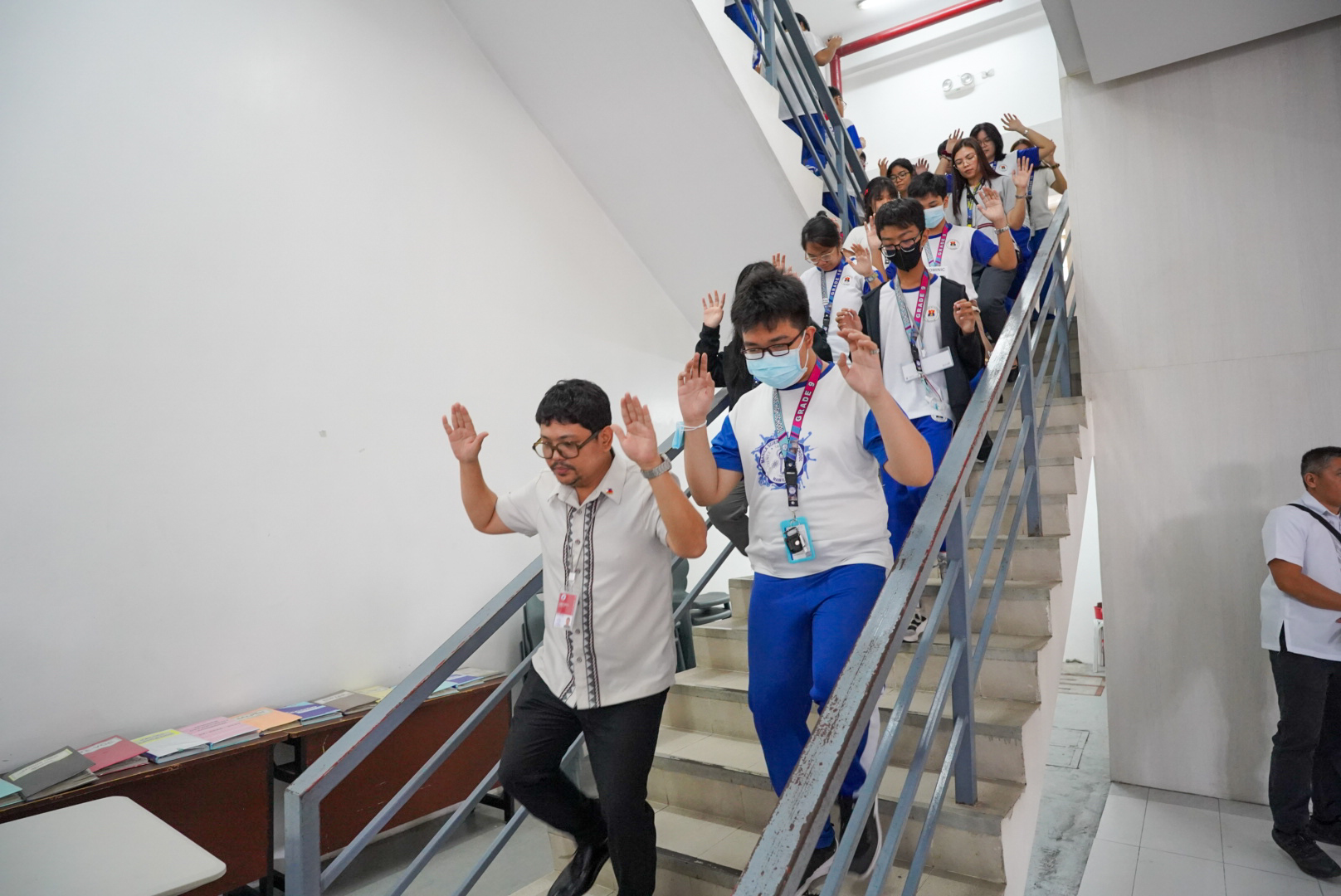
The Department of Education (DepEd) piloted nationwide active threat simulation drills in public schools on Wednesday, to stress-test emergency response protocols and bolster campus security.
Education Secretary Sonny Angara led the launch at the National Safe Schools Summit and Safety Drill held at Manila Science High School. During the event, learners, school staff, and local authorities participated in synchronized lockout, lockdown, and rapid evacuation simulations, designed to ensure a swift and organized reaction to potential active threats.
Secretary Angara has directed all public schools to develop active threat response plans tailored to their specific environments, moving away from a one-size-fits-all approach in favor of localized, immediate action.
“This fight is not DepEd’s fight alone; it is a challenge we must face together, especially given the complexities we have seen in recent weeks. We rely on the active support of our parents, families, communities, local governments, and our partners across all levels of government to ensure our schools remain safe havens,” Angara said.

“Our focus is on proactive prevention and readiness, because adhering to safety protocols is a vital step in saving lives,” he added.
The initiative is part of a broader government effort, aligning with President Ferdinand R. Marcos Jr.’s directive to enhance protective measures across campuses following recent incidents of school violence.
Angara emphasized that the focus is on proactively protecting the school community through preparation and prevention, noting that they are currently retraining staff while strengthening the existing foundation of school safety.
During the drill, which simulated an active threat, learners and teachers practiced lockdown procedures for scenarios where escape was not possible. Participants locked and barricaded doors and windows, turned off lights, silenced devices, and stayed low until law enforcement arrived and arrested the suspect. Once a safe path was confirmed, teachers guided learners to evacuate immediately, keeping hands visible while proceeding to the designated school reunification zone.
The National Safe Schools Summit convened key stakeholders to unify campus security strategies, strengthen inter-agency collaboration, and pilot active threat simulation drills.
The event utilized a whole-of-community approach, bringing together the national government agencies, local government units (LGUs), civil society, and private institutions to establish a synchronized, nationwide safety framework.
“We can no longer allow security threats to place the lives of our learners in harm’s way,” said Secretary Angara. “Mahalaga na handa tayo sa pagharap sa anumang banta. Dapat ay wala nang pamilyang muling magluluksa dahil sa trahedya sa paaralan.”
Breakout sessions provided guidance on critical security components, including school contingency plans for active attacks, psychological first aid, learner rights protection, and cyber-safety concerns. Additionally, the sessions covered the use of the Adopt-a-School Program and the Special Education Fund to resource campus security improvements like CCTV systems and essential equipment.
The initiative is anchored on reinforcing the implementation of the DepEd Guidelines on Ensuring a Safe and Motivating Learning Environment (ESMLE) under DepEd Order No. 006, s. 2026, issued last March. The framework harmonizes existing learner rights protection policies and school safety protocols into a cohesive mechanism for both prevention and response.
Reiterating the importance of community involvement, Angara thanked partner agencies, including the Philippine National Police (PNP) and Bureau of Fire Protection (BFP) for ensuring police visibility in schools and praised LGUs that continue to provide CCTV systems, security equipment, and essential resources to strengthen campus safety. The Secretary also thanked the Department of Interior and Local Government (DILG) for the Unified 911 hotline, which provides 24/7 emergency response support.
“Sama-sama nating isulong ang kultura ng kahandaan sa ating mga paaralan, dahil ang bawat buhay na ating napoprotektahan ay hakbang tungo sa mas ligtas na kinabukasan para sa kabataan,” Angara said.
