


Following its completion of all 105 target textbook title procurements for 2026, the Department of Education (DepEd) is strengthening its Learning Resource Management and Information System (LRMIS) to improve the tracking of textbooks and teachers’ manuals at the school level.
DepEd said it has secured all 105 approved textbook titles for public elementary and secondary schools, covering the successive phases of curriculum implementation from 2024 to 2026.
The procurement milestone addresses long-standing bottlenecks identified by the Second Congressional Commission on Education (EDCOM II), which noted that DepEd procured only 27 of 88 required titles from 2014 to 2023. With the 105 printed and electronic titles now moving through procurement and nationwide distribution, the Department said real-time school-level tracking through LRMIS will be crucial in monitoring deliveries and ensuring resources reach the schools and learners that need them.
Education Secretary Sonny Angara said the next challenge is to ensure that procured learning resources are properly tracked from national distribution to the school level, accounted for, and allocated where they are most needed.
“Natapos natin ang isang malaking bottleneck sa procurement. Pero hindi doon natatapos ang trabaho. Kailangan nating makita kung nasaan na ang textbooks, ilan ang hawak ng bawat school, anong grade level at learning area ang kulang, at saan puwedeng mag-reallocate kung may sobra o buffer stock. Iyan ang inaayos natin sa LRMIS,” Angara said.
DepEd explained that achieving a 1:1 textbook-to-student ratio requires more than procuring the required number of books. Enrollment varies annually across schools, grade levels, and localities, while textbooks may also be lost or damaged during use.
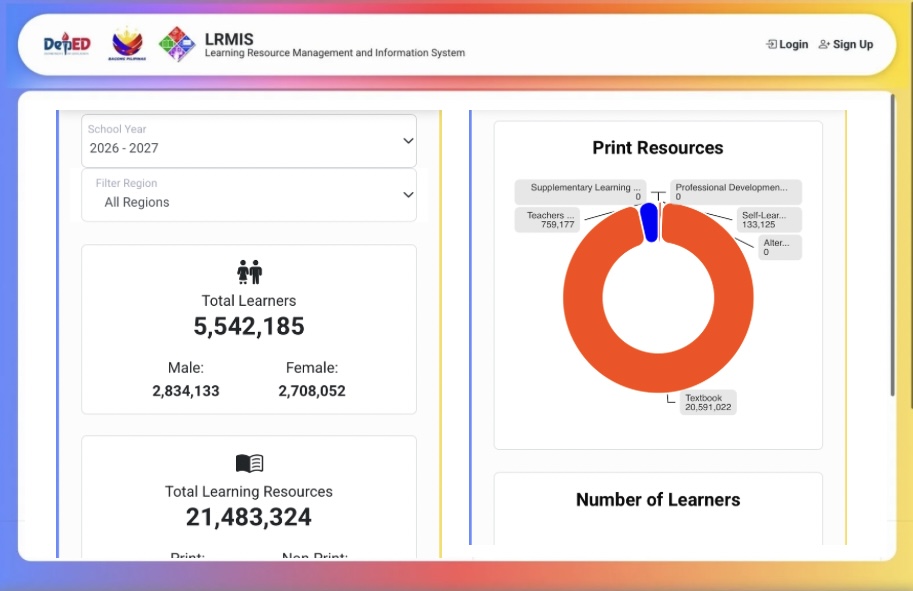
Through LRMIS, schools can encode inventory by learning resource, grade level, and learning area and compare these figures with current enrollment. This allows DepEd to identify shortages, verify deliveries, and guide the reallocation of available buffer stock.
The system provides a centralized learning resource database, real-time inventory visibility, standardized reporting, and automated data-driven reports across schools, Schools Division Offices, Regional Offices, and the Central Office.
As of August 27, 2026, 37,705 public schools, or 78 percent of all DepEd schools, had registered on LRMIS, while 17,797 schools had encoded their existing textbook and teachers’ manual inventory. The latter represents around 37 percent of all DepEd schools and 77 percent of schools covered in the current encoding phase. Schools had also encoded 20,520,035 learning resources based on extracted regional inventory data.
“May mga lugar na naapektuhan ang encoding dahil sa masamang panahon, at inuuna natin ang safety at operasyon ng schools. Pero tuloy ang rollout. Habang mas maraming schools ang nag-e-encode, mas malinaw nating makikita kung saan kulang, saan sobra, at saan kailangang maglipat o magdagdag ng learning resources,” Angara said.
DepEd said LRMIS responds to the need for more detailed and actionable textbook data, particularly amid discussions on whether learning resources have already reached schools. Instead of relying on broad categories such as complete, partial, or none, the system is designed to show actual quantities at the school level, broken down by grade level and learning area and matched against current enrollment.
Currently in Phase 1, LRMIS covers school registration and baseline inventory of textbooks and teachers’ manuals. The next phase will provide real-time inventory data alongside current enrollment, support the reallocation of textbooks, facilitate reports on damaged resources for replacement, and generate standardized reports based on the needs of each DepEd office.
Through LRMIS, DepEd aims to strengthen accountability in textbook management and ensure that learning resources are tracked more effectively and directed more quickly to schools and learners that need them most.
