


The Department of Education (DepEd) is stepping up its efforts to combat cyberbullying in schools, with Education Secretary Sonny Angara warning that severe cases of online harassment will face strict disciplinary action under the agency’s newly consolidated guidelines.
The intensified enforcement comes as the Philippines posts its strongest-ever performance in the Programme for International Student Assessment (PISA) 2025, with significant gains in Science, Mathematics, and Reading. However, the assessment’s learner well-being findings also highlighted the continuing importance of ensuring safe and supportive learning environments.
While reports of physical bullying have declined since 2018, including a 17-percentage-point drop in learners who reported being made fun of or being hit or pushed, cyberbullying has emerged as an evolving threat to learners’ well-being, focus, and ability to learn.
Angara said the progress reflected in the PISA results must be matched by stronger efforts to protect learners.
“Our learners have proven that they have the grit, curiosity, and drive to improve, as shown by our gains across all PISA domains. However, our children must also feel safe,” Angara said.
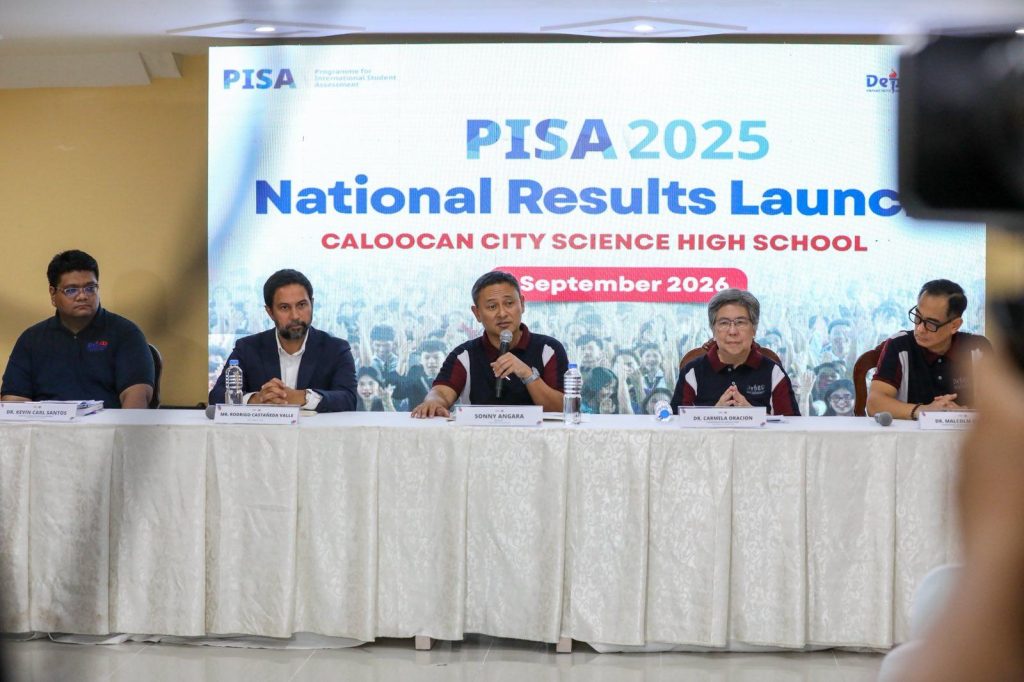
“While we take note that physical bullying reports are down compared to 2018, the PISA findings reinforce that cyberbullying is a serious challenge that requires a firm, direct response. Our guidelines establish clear due process, but online cruelty will not be tolerated. Safe digital spaces are non-negotiable for basic education,” he added.
Under DepEd Order No. 6, series of 2026, or the Guidelines on Ensuring a Safe and Motivating Learning Environment (ESMLE), schools may take action against certain off-campus online conduct when it creates a hostile environment, violates a learner’s rights, or disrupts school operations.
Severe forms of cyberbullying, including the sharing of degrading videos, circulation of explicit content, and threats against learners or school personnel through social media, are classified as high-level offenses. These may trigger formal investigations and disciplinary measures ranging from suspension and non-readmission to exclusion, which removes the learner from the school list and places them in an alternative education program, without prejudice to possible legal liability.
DepEd is also strengthening preventive measures by integrating digital citizenship, socio-emotional learning, and values education into the basic education curriculum, complemented by co-curricular programs.
During the observance of Safer Internet Day, DepEd partnered with the Stairway Foundation Inc. (SFI) to conduct classroom discussions on online risks and cyberbullying, reaching around 4.9 million learners.
Through its Kaagapay Program, DepEd also equips parents and parent substitutes with information to help them identify online threats and discuss sensitive digital safety concerns with children.
Schools are likewise encouraging learners to participate in sports, youth formation and other co-curricular activities, including learner government, school clubs, scouting, journalism, and the arts, as avenues for positive engagement and personal development.
Meanwhile, DepEd has convened a high-level inter-agency meeting to establish a threat assessment and verification mechanism aimed at strengthening the response to online threats affecting schools.
The initiative brings together DepEd, the Department of Information and Communications Technology (DICT) Cybercrime Investigation and Coordinating Center (CICC), National Bureau of Investigation (NBI), Philippine National Police (PNP), Commission on Higher Education (CHED), and Department of Social Welfare and Development (DSWD).
The proposed end-to-end framework seeks to standardize the handling of incidents, from initial threat reporting and evidence preservation to technical verification, protective action, and formal case closure.
Under the proposed inter-agency protocol, cybercrime and law enforcement agencies will lead digital investigations, while schools will retain authority to implement immediate and proportionate safety measures and learning continuity plans.
With the latest PISA results showing continued progress in academic performance, DepEd is reinforcing its position that learner safety, both in physical classrooms and online spaces, must remain a key part of sustaining that progress.
